Ash Grange Nursery and Primary School
English
Curriculum Intent:
Our first priority for children, is the ability to speak in line with their peers nationally, so that they can start their journey with us towards becoming confident and effective communicators. We foster a love of reading for pleasure; children who read fluently and comprehensively, who can express preferences and opinions about the texts they read. All children have access to a wide range of text types, genres and authors to enable them to make informed opinions about their favourites. Through enjoyment of high-quality texts, we expose our children to a wide range of vocabulary so that they are able to decipher unfamiliar words and then use them when speaking and writing, both informally and formally. We aim to develop a love of writing, to equip children with the ability to write with imagination, confidence and accuracy, for a variety of purposes and audiences, whilst developing their own individual flair. We teach our children to write with grammatical accuracy and be able to apply spelling patterns correctly, using a neat handwriting style. Reading
We nurture a love of books and reading, as it unlocks the world.

The reading books are banded by the Book band system, using a range of authors and companies' books. Children move through the colours and receive a certificate for each level to identify what they can now do and their next steps. When they achieve a reading level, the children are awarded a book prize. By the time they leave school, the children have a 20-book library to keep and treasure.
 |
An example of a reading certificate. This is presented in assembly and parents are sent the details through Marvellous Me. |

There is a reading jungle containing the banded books that the children choose in the centre of the school. Our Rainbow library is organised by book spine colour not text difficulty, so that children can enjoy books outside their reading stage. The Rainbow library has a range of fiction, non-fiction and poetry for children to enjoy. In addition, there is an age-appropriate collection of non-banded fiction, non-fiction and poetry books in each class.

There are daily opportunities to read at school in 1:1, small and large group situations.
Each class has a daily class reading time. Younger children select from their class libraries, Years 2 to 6 have a different class novel each half-term. See the class learning curriculum for details of this half-term's book.
Reading Certificates
Handwriting
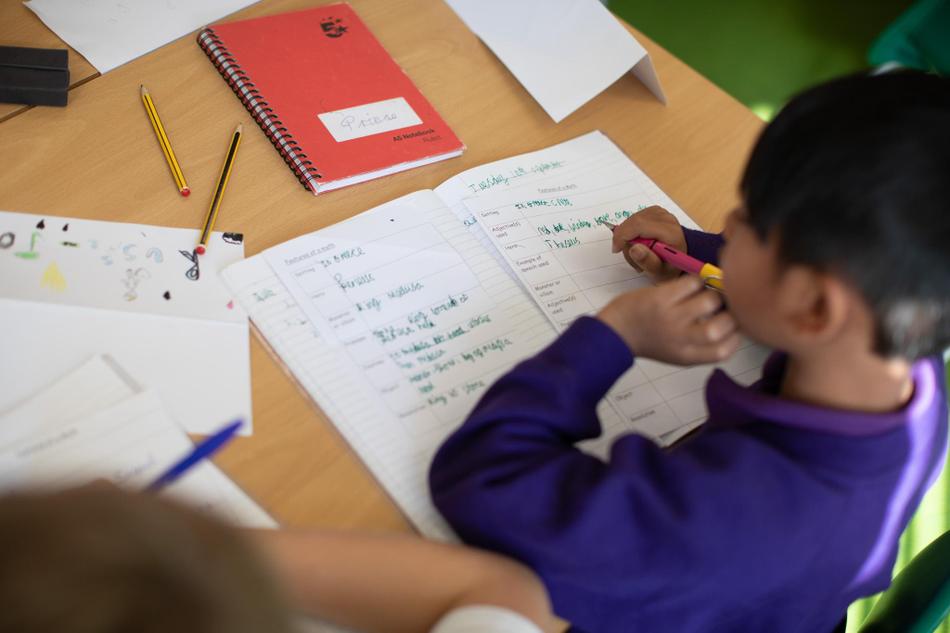 |
Step 1 Children learn to form single letters (using the Little Wandle shapes, e.g. a in the shape of the astronaut's head) writing in pencil – expected by the end of Reception Year, if not before. Step 2 Children are consistent with the height and width of a letter and learn to add lead in and out, using a pencil. Using the school method of sky, grass, ground for placement on and below the line. This is expected by the end of Year 1, if not before. |
|
Step 3 When the child can join pairs of letters and does Step 2, they are awarded a pen licence and can use a school pen (their engraved fountain pen is ordered at this point). This is expected by the end of Year 2, if not before. Step 4 Children write, joining more and more letters together, until they can write in a joined fluid script; at this stage, they are awarded their fountain pen, which is presented at the whole school celebration assembly. Children move through the stages at their own pace, but by Year 3 it is our intention that all children are able to write in joined script. These steps are adapted for any child with additional needs, e.g. SEN. |
 |
Ink Colours
The school colour is dark blue ink. There is a different ink pen colour for each term which children receive for excellent handwriting and presentation skills. Termly ink colours are : Autumn Term - Orange, Spring Term - Green and Summer Term - Sky Blue.
Equipment
a) Children write in pencil, modified based on their needs, e.g. chunky pencils with grips.
b) When the children achieve their Pen Licence: Children write in a school pen, modified to their needs, e.g. different types to allow child to write well. Left-handed pens are provided as standard.
c) When children present their work well, in fluent script, they are awarded an engraved fountain pen, in the colour of their choice.
Our Handwriting Script and Steps to forming letters the Sky, Grass, Ground way.
Phonics
We are passionate about spelling at Ash Grange as this is the gateway to reading and writing. Scroll down this page to see the programmes for different age groups.
Children are taught to play with and understand sounds from their early years throughout primary school. We use the revised Little Wandle scheme, which teaches children sounds, digraphs and tricky words so that they have the phonics and word recognition knowledge and skills to read and write.
Nursery, Reception and Year 1 follow it from the beginning of their relevant year. Children in higher years will only be participating in Little Wandle if they have a significant learning gap/SEN need. This will be identified as an intervention on their IPP that the class teacher shares with parents/carers.

Dear parents/Carers,
When children reach phase 5 of Little Wandle, this integrates with Spelling Shed.
This is a full programme of teaching and learning used in lessons over the school week and then there is a homework side to consolidate the learning from the week. The homework is a game-based tool, where children practise their spellings in a fun, interactive way.
Your child will need to complete a minimum of 4 games set by their teacher each week, but can continue to play beyond this to earn points for their avatar! They can select the level of games to meet their needs – but they will earn more points for more challenging levels!
Your child will be given their login information, and they can access Spelling Shed online here: https://play.edshed.com/en-gb/login. The website can be accessed using a computer, phone or tablet. There is an optional app that can be purchased, but this is not required. Attached is a Parent's Guide to support you with Spelling Shed at home.
Thank you for supporting your child's learning at home.